
Escape the concrete and crowds to little-known corners near Varna
For most Bulgarians, Varna is synonymous with summer, sea breeze, freedom and carefree days. We all love this city — and no wonder! We’ve strolled through the Sea Garden and along the breakwater, eaten fried sprats at the seaside taverns, sipped cocktails on the beach, explored the city museums, art galleries and charming boutique shops. And of course, we know the nearby resorts of Golden Sands, St. Constantine and Helena, and others well.
We’ve visited Balchik, Cape Kaliakra, and so on. Let’s say we’ve already discovered the natural wonder of the Stone Forest (Pobiti Kamani) — the only desert of its kind in Europe — and the remarkable Aladzha Monastery, the best-preserved rock monastery in Bulgaria. We’ve ticked off most of the well-known sights in the area, but we want more and more new experiences, new encounters with nature and with history.
Because nearVarna there are still corners little explored by the average tourist — places that will fill your eyes with beauty and your soul with peace, and awaken the desire to seek new horizons, both within and beyond yourself.
1. The Museum of the Russian Old Believers in the village of Kazashko – 9 km from Varna
Kazashko is practically a neighbourhood of Varna — you can reach it in about 15 minutes from the city centre. It sits on the shore of Lake Varna, far from the noise and chaos of Bulgaria’s seaside capital. In the heart of the village, right across from the mayor’s office, you’ll find a small, tidy building with a beautifully painted fishing boat proudly displayed in front of it.
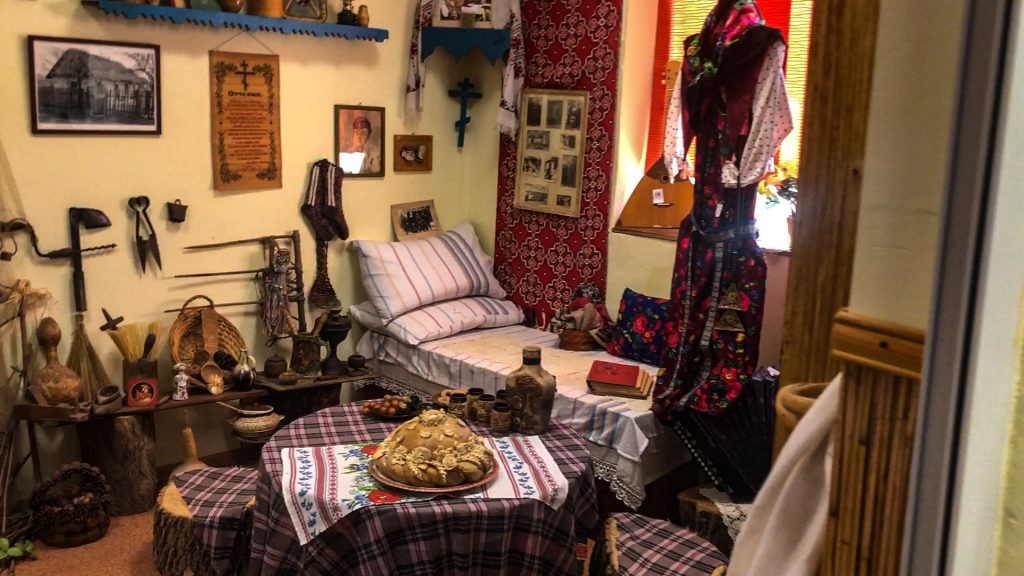
This is the Cossack Cultural Centre, home to a unique museum collection assembled from donations by local residents. Here visitors can learn about the history and way of life of Kazashko and the Old Believer Cossacks who settled on the shores of Lake Varna more than a century ago.
What is a kokoshnik, a garmozhka and a lipovanochka — and how do the residents of Kazashko preserve the spirit, customs and culture of the Old Believer Cossacks? Watch my original video and hear from Mayor Gergana Petkova:
The recently renovated building also houses the Sunday school of Kazashko village with the “Kazacheta” (Little Cossacks) club, where children learn Russian and study traditional Cossack songs, dances and everything connected to the culture of their ancestors. The centre was founded on the initiative of the dedicated Mayor Gergana Petkova — the only female ataman (Cossack leader) in Bulgaria.
Who are the Cossacks of Kazashko?
Old Believer Cossacks founded the fishing settlement in the 17th century. They fled forced church reforms and Peter the Great’s attempts to modernize Russia. These long-bearded Cossacks and their families scattered across the world. A sizeable group settled in the Danube Delta in Romania. From there, several Old Believer families made their way to the shores of Lake Varna, where in 1905 they founded the village of Kazashko. On this tranquil lakeside shore, the long-bearded Cossacks found their happiness and destiny — along with a guarantee from the authorities that they could freely practise their ancient Orthodox faith.
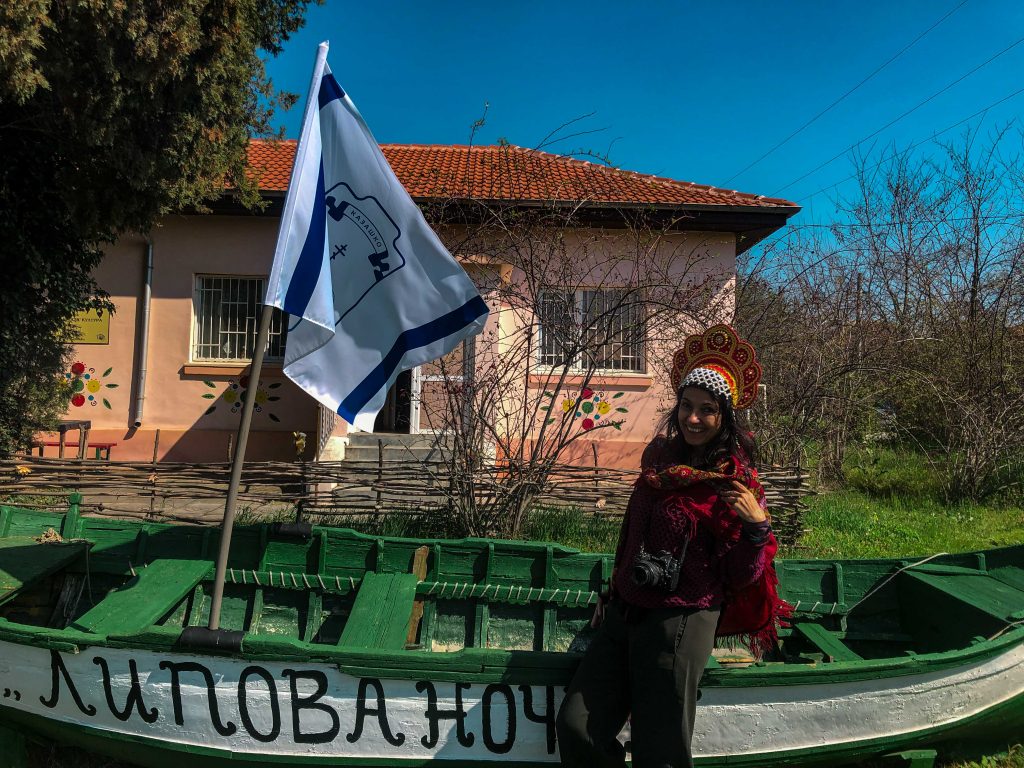
They are also known as Lipovans or Old Believers. Today their descendants form the smallest ethnic community in Bulgaria, and proudly call themselves Cossacks — they have never lost their connection to their Cossack roots in distant Russia.
If you’d like to visit the museum, contact the mayor’s office to have it unlocked for you. And don’t miss a walk along the village’s lakeside shore, which opens up beautiful views of the shimmering blue water — a favourite spot for photographers and painters, especially at sunset. I’ve seen truly stunning shots taken here.
2. The Tekke in the village of Obrochishte – 30 km from Varna
Few people think to stop at the village of Obrochishte while travelling in the area near Varna on the way to Balchik or the Albena resort. The place is greatly underrated by the average holidaymaker, who has no idea that a genuine cultural and historical treasure lies here — one that transcends both time and religious boundaries, offering visitors a sense of peace, and for some, even hope for healing.

The architectural monument stands right by the road, marked with a large sign, so you can’t miss it. It sits within a reasonably well-maintained park with information boards containing detailed historical facts. This is a sacred religious site venerated through the centuries by both Muslims and Christians alike. It was once a place of prayer for the Muslim spiritual leader Ak Yazılı Baba, as well as for his Christian counterpart, St. Athanasius. Depending on their faith, people called it either “the tekke” (a Sufi lodge) or “the monastery.”
It is believed to have been founded in the 16th century as a dervish retreat. Everyone who comes here feels a strong surge of positive energy. The complex consists of two buildings — a türbe (mausoleum) and an imaret (a soup kitchen/community hall). Remarkably, both buildings are in the shape of a perfect heptagon (seven-sided polygon). The tomb of the saint Ak Yazılı Baba is located here, where devout Muslims leave their offerings and say their prayers.

According to Christians, there was once an old monastery on this site
which at a later stage was converted by Muslims into a dervish lodge. Legends surrounding the Tekke of Obrochishte tell of Saint Athanasius, who was killed by the Ottomans for his unwavering faith. Another tale speaks of the impossible love between a young shepherd named Atanas and a beautiful Turkish girl, ending in the tragic suicide of the mixed-faith couple.
The place was deserted on our early spring visit. No one unlocked the buildings for us. We later learned a guide usually shows guests around and gives an interesting talk. The entrance fee remains 5 BGN (approx. €2.50) as of 2026. You should check in advance whether a guide will be available. If you want to photograph the site or take a selfie, there is an additional fee of 10 BGN.
3. The Chapel above the village of Padina and its surreal lake – 35 km from Varna
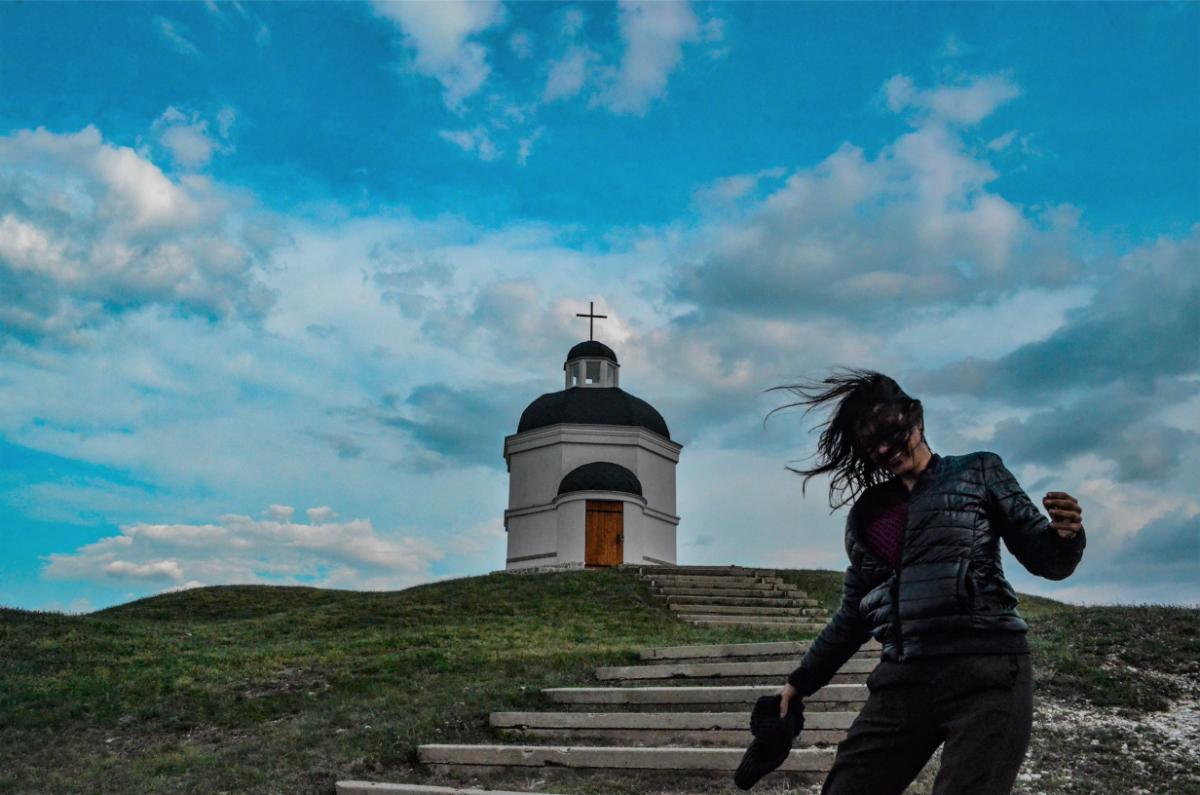
This is one of the most famous and most photographed chapels not only near Varna, but in all of Bulgaria. You’ve probably seen it in photos online. Everyone comes here to capture its solitary, wind-battered silhouette perched on top of a hill — visible from the entire plain that stretches out at its feet. The name of the village of Padina (meaning “hollow” or “low-lying place”) comes precisely from the fact that its houses are scattered low down in the dip of the valley.

Unfortunately I couldn’t find any information about the chapel. It appears to have been built recently, but was locked. We peeked through the windows and saw that the walls inside are covered with people’s names. We arrived in a near-hurricane wind which, up on the hill, almost swept us off our feet.
As a backdrop to the ethereal chapel, a strikingly beautiful lake spreads out below, shimmering in shades of emerald and turquoise. The colour is so unnatural that it looks like it’s been over-processed in Photoshop by an amateur photographer. This artificial basin collects toxic wastewater from the Devnya industrial plants. It also serves Solvay Devnya, one of Bulgaria’s largest chemical factories.
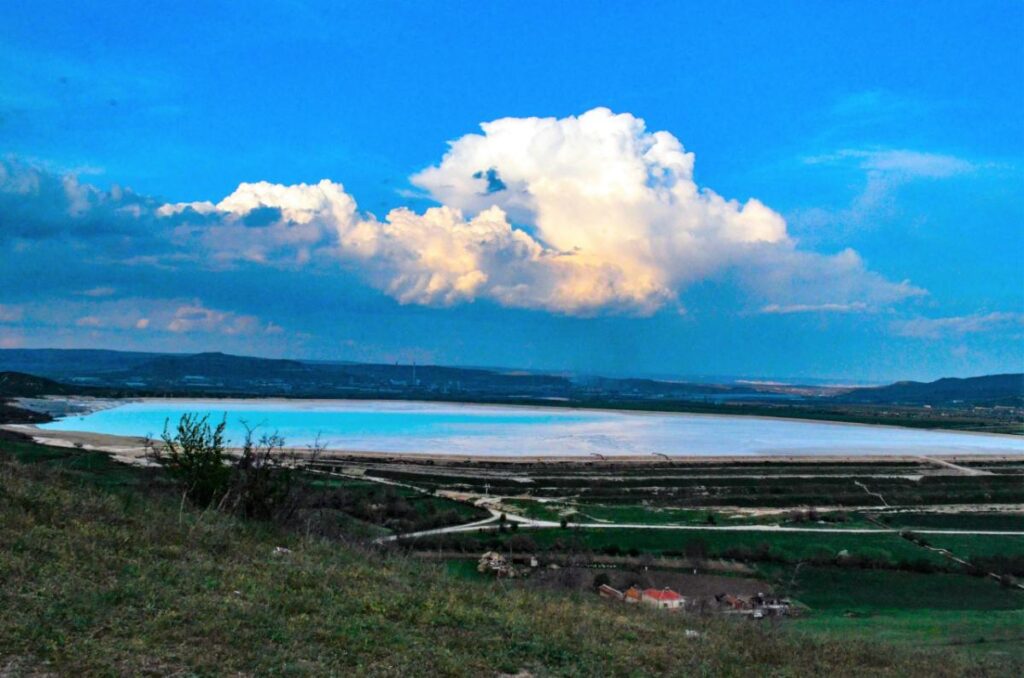 If you look closely, you’ll notice smoke drifting above the lake. The white fumes result from a toxic, most likely lethal, chemical reaction. Fortunately the wind was blowing in the opposite direction, otherwise the vapours might have reached us. 🙂 None of this, however, detracts in any way from the otherworldly beauty of the place. On the contrary — it adds an extra surrealist touch!
4. A mosque beside a fairytale castle in the village of Drăndar, on the way to Nikolaevka Reservoir – 35 km from Varna
If you wander aimlessly in the area near the Varna, you may stumble upon another surreal scene worthy of a Disney animated film. I’m talking about the village of Drăndar in Suvorovo municipality and its beautiful mosque . Its minarets shoot up into the sky right next to the cone-shaped blue rooftops of a fantastical castle. These two extraordinary structures stand out dramatically against the backdrop of poor village houses with sagging roofs and chickens wandering along the dusty road.
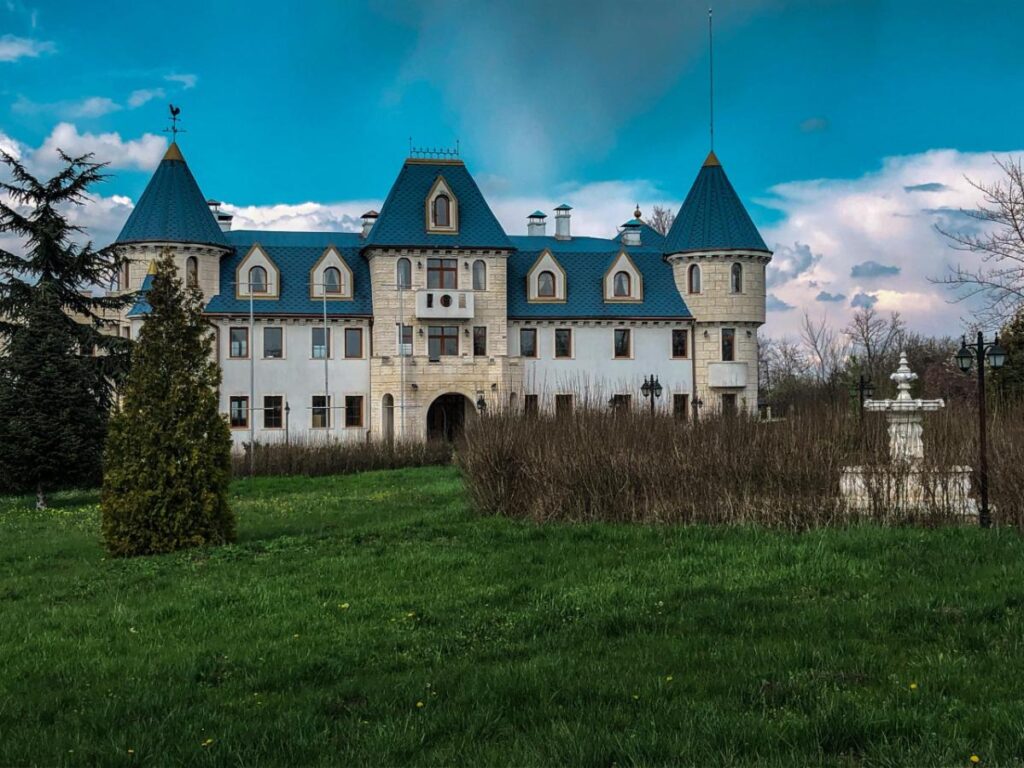 Drăndar is the home village of Ahmed Dogan, the founder of the Movement for Rights and Freedoms (DPS) — Bulgaria’s largest ethnic Turkish political party. It was here, in 1989, that he established the party. He later built the striking castle, which to this day stands empty. Everything about it suggests that no human foot has set foot here in years. The castle seems to have sunk into an eternal sleep, much like its counterpart in the fairy tale of Sleeping Beauty. The building, which looks as though it’s been constructed from polystyrene, has stood untouched amid an overgrown courtyard for years. And remarkably, no one has ever thought to jump the fence to explore it — or to vandalise and loot it. For entirely understandable reasons.
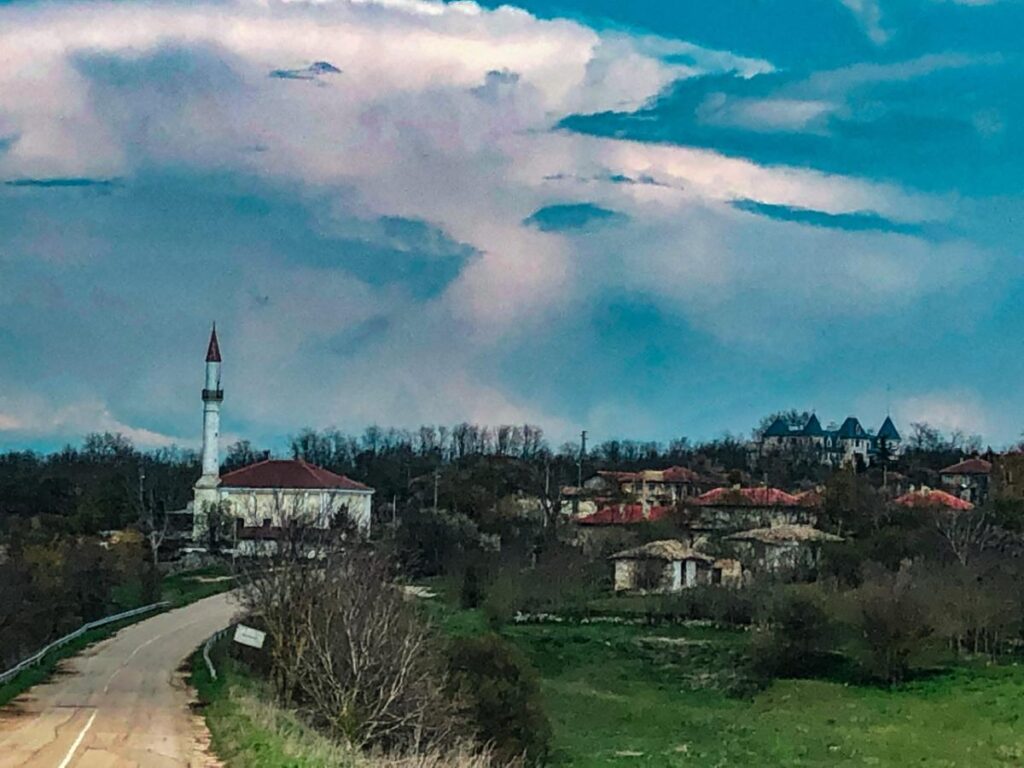 Drăndar has no more than 150 permanent residents, all of them ethnic Turks. The village name translates as “wool carder” in Turkish. The large mosque was built in 1870, but was destroyed by a landslide and remained closed for 50 years, only being restored in 2002.
A few kilometres from Drăndar lies another hidden gem —
Nikolaevka Reservoir
This is one of the largest reservoirs in the Varna region. It is named after the neighbouring village of Nikolaevka, which is the birthplace of Petar Danov (also known as Beinsa Douno) — the founder of a spiritual movement called Universalthe White Brotherhood, which still has followers in Bulgaria and beyond. The village’s old name was Hadărcha.


The place is a photographer’s paradise. It is also a favorite spot for anglers. The waters hold carp, catfish, and even crayfish. Nikolaevka remains very well maintained. The banks are clean and free of the usual rubbish found in other water bodies. They are unspoiled and peaceful, with good facilities for picnicking and sunbathing. These are, of course, my personal impressions from a visit in May — and we left very satisfied.
5. The Karst Springs near Devnya – the largest in Bulgaria – 31 km from Varna
I had long wanted to visit this place! The Magical Spring flows freely today. It is part of a group of 30 karst springs. Together, they produce 3,200 liters of water per second. These springs are a natural wonder. However, nearby factories and the cities of Devnya and Varna capture most of the water.

Only the Magical Spring flows freely, in a beautiful natural setting. Commercial use has even drawn this spring into its grounds—for unknown reasons, it now sits within a private tourist complex. The owner kindly let us visit the spring without requiring a restaurant purchase. He even pointed out exactly where the water bubbles up. A lovely ornamental pool has been created around it. According to legend, this spot was a favourite walking place of Marciana — the sister of the Roman Emperor Trajan. In the 1st century AD, Trajan conquered the nearby Thracian settlement and named it after her: Marcianopolis. Today, the city of Devnya stands on the site of that ancient Roman town.
6. The Museum of Mosaics and the Treasure of Marcianopolis – 33 km from Varna
Devnya is a major industrial centre, so few people imagine that the town could have anything to offer tourists. But in fact it has a great deal for lovers of antiquity. The ancient Marcianopolis was one of the largest cities founded during the Roman period in this part of the Balkans.

Beautiful public buildings once rose here: a basilica, a library, baths, and a triumphal arch. Exquisite mosaics decorated the floors of private homes. Bulgaria’s only Museum of Mosaics displays some of these pieces on the site of an ancient villa. Experts rank them among the finest examples of Roman mosaic art. Artists created these works in sixteen colors using ceramics, clay, glass paste, marble, and limestone.

The museum also displays a golden treasure discovered in late 2019 during excavations near the museum building — 19 Roman gold coins minted around 1,600 years ago. The museum is included in Bulgaria’s list of 100 National Tourist Sites and offers an unforgettable journey into antiquity.
7. The Salt Pit near Provadia – 48 km from Varna
A massive stone fortress rose near present-day Varna thousands of years before Egypt’s first pyramid. Salt production fueled the growth of the Old World’s oldest known city. This discovery rewrote European prehistory.This happened nearly 7,000 years ago, and the place is today’s town of Provadia. Archaeological excavations are ongoing here, and the site’s director, Prof. Vasil Nikolov, sometimes personally shows visitors around and shares fascinating details about the lives of our distant ancestors.

The archaeological site lies within the grounds of the private company Solvay Sodi Devnya near Provadia, but tourists are permitted to enter and explore it. To do so, simply speak to the security staff at the main entrance. A separate visitor route with direct access to the site is currently being considered.
For more about the Salt Pit near Varna – see my article: The Salt Pits near Provadia — the Mint of Europe.
Discover 3 more ideas for off-the-beaten-track day trips around Varna in my latest video from this summer: